


12/24/13
The Tutorial
The semantics of relations proceeds in much the way one would expect-- the new item that has to be taken account of is the order of the terms (because, for example, Tab is not at all the same thing as Tba -- Arthur being taller than Beryl is not the same as Beryl being taller than Arthur).
Let us start with an Interpretation
Interpretation 1
Universe= {a,b}
F={a}
Remember, there needs to be an account of how the various symbols in the predicate logic formulas apply in this Universe. There are the constant terms a,b,c... -- at an introductory level we can just let a name a, b name b etc. There are the predicates -- here we just have to say which members of the Universe a predicate applies to, and this can be done by writing, for example, F={a} to mean that a has the property F; many properties will not apply to any of the objects in the Universe, if, for example, G applies to nothing, this could be written G={} or nothing need be written at all.
There are also now the relations -- here we just have to say which members of the Universe a relations applies to, and this can be done by writing, for example, R={<ab>} to mean that a bears the relation R to b (in that order); many relations will not apply to any of the objects in the Universe, if, for example, S applies to nothing, this could be written S={} or nothing need be written at all.
[There are two alternative common notations for ordered pair: <ab> is one, and (a,b) is the other. We prefer <ab>, however angle brackets forming a tag, say <h1>, is common html, xml, svg, etc. and these are all technologies used extensively here. So, to avoid some issues with programming we occasionally use (a,b).]
Now consider
Interpretation 2
Universe= {a,b}
F={a}
R={<ab>}
The formula Rab is true under Interpretation 2. The formula Rba is false under Interpretation 2. The formula Sab is false under Interpretation 2. The formula Rab∧Fa is true under Interpretation 2. The formula (∃x)Rax is true under Interpretation 2. And so on...
Exercise to accompany Predicate Tutorial 13.
The Interpretation in Predex13 shows an Interpretation similar to this
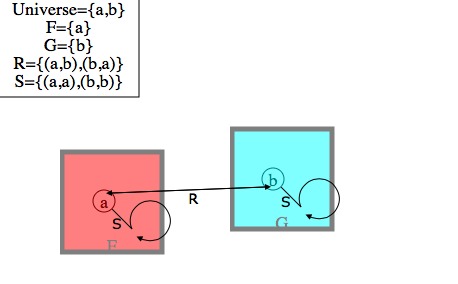
if it does not, draw a similar one yourself. The diagrammatic conventions are as follows. The named circles are individuals; the rectangles show properties, which individuals may or may not have; relations are shown as a labeled arrow from one individual to another; it is possible for a relation to related an individual to itself (as in Jim likes himself i.e. Ljj), to depict this the labeled drawn arrow follows part of a circle back on itself. The Intepretation Board (top-left) shows exactly what the interpretation is.]
Exercise 1(of 1)
Interpretations Applet
Should you wish to use the Deriver application for this, see Exercises for Easy Deriver using the Deriver Web Application [Gentzen] . Or, more directly, Deriver20 [Gentzen]. Good advice is: start these tutorials without it, but if you get to the point of wishing to save some work, then switch to the Deriver Web Application.
Then either copy and paste the above formulas into the Journal or use the Deriver File Menu to Open from URL... with this address https://softoption.us/test/easyDeriver/CombinedExercisesEasyDGentzen.html .